
WaterLove › Kayaking
Kayak weather, scored for your paddle
WaterLove reads the National Weather Service forecast, NOAA tides and nearby buoys for your launch, and scores every hour from 0 to 100 on how well it matches the paddle you like. Then it shows you why.
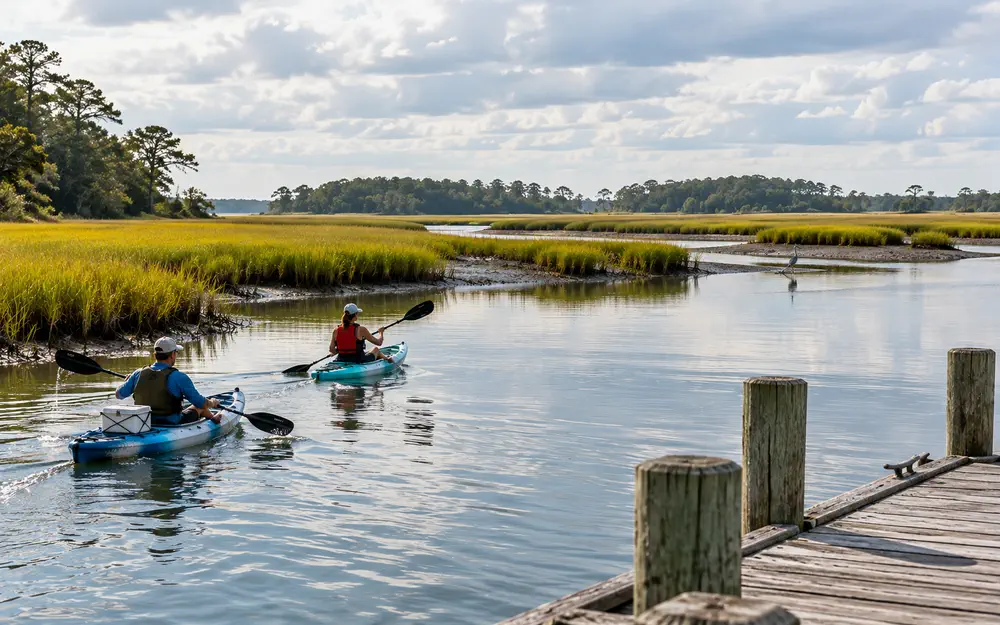
Wind counts most
For a kayak, the wind counts for more of the score than anything else. Calm water scores highest, and the score falls as the wind builds. When the wind is past what the boat handles, the whole hour is held down, however warm and dry the rest of it is.
Gusts and chop count too, and so do how warm it feels, the water's temperature, the chance of rain and the air quality. You tell WaterLove what you like, and every factor is scored against it.
What WaterLove reads for kayaking
The factors that count, and which way each one leans. In the app, every score shows what each factor added to it, and Preferences shows the comfortable range for each; with Premium you can set your own.
The average wind speed for the hour.
Calmer hours score higher.
The strongest gusts the hour is forecast to bring.
Lighter, steadier gusts score higher.
Wave height on the water.
Flatter water scores higher.
How the air feels: the air temperature, or the heat index when humidity makes it feel hotter.
Comfortable warmth scores highest; cold and heat both score less.
The water's temperature, from NOAA and USGS sensors.
Comfortably warm water scores highest.
The chance of rain in the hour.
A lower chance scores higher.
An estimate of biting insects from the wind, the time of day, temperature, season and humidity. Not measured.
Fewer insects score higher.
In a state with no tide, on a river near a USGS gauge, the river's level there, against the Weather Service's action stage for it.
A lower river scores higher.
In a state with no tide, on a river near a USGS gauge, whether the river there has been rising or falling.
A steady or falling river scores higher than a rising one.
EPA AirNow's air quality index for the area, today and tomorrow; later days are scored without it.
Cleaner air scores higher.
Your experience counts
Experience affects how WaterLove evaluates conditions. It doesn't limit what you can choose. It makes the score higher or lower under different wind and wave conditions. For kayaking it changes how much wind, gusts and waves still count as a match: Limited narrows it and Expert widens it. Temperature, water and rain stay as they are, because experience does not make cold water warmer.
- Limited. Still learning. Start with less challenging conditions.
- Experienced. Comfortable with typical conditions.
- Expert. Comfortable with more challenging conditions.
Rules that come before the points
- Storms count hour by hour. The chance of a thunderstorm caps that hour's score before a window is averaged, so one stormy hour cannot hide inside a calm afternoon. The higher the chance, the lower the cap.
- The wind holds the hour down. When the wind is past what a kayak handles, it holds down the whole hour's score, however warm and dry the rest of it is.
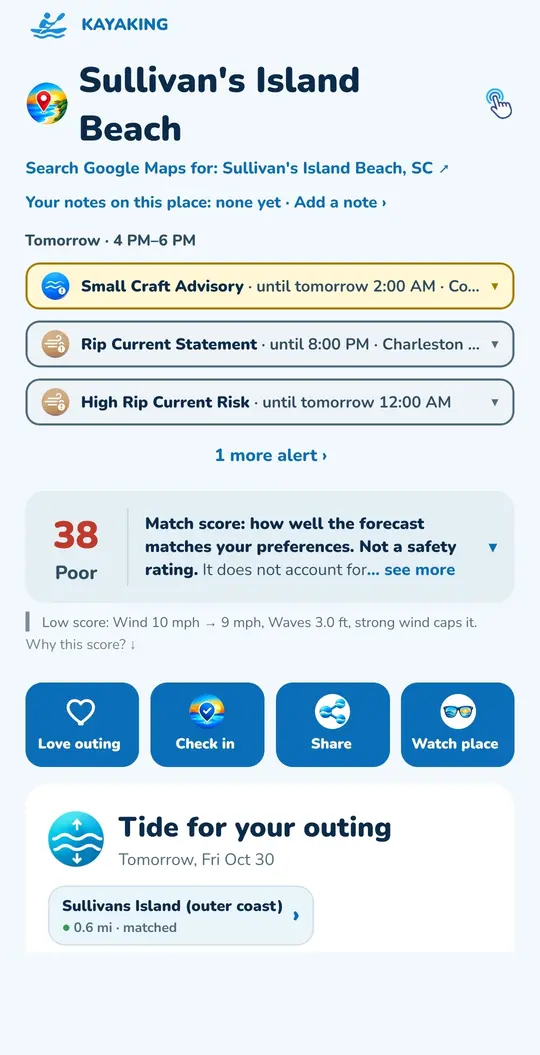
- Warnings come first. Some National Weather Service alerts for your place, such as a Small Craft Advisory or a Special Marine Warning, hold kayaking at Poor match, and the alert is shown in the Weather Service's own words; some others are shown on the result as a caution and leave the score as it is. WaterLove is not an emergency-warning service and may not display every warning or hazard affecting a location. Always check official warnings and local guidance.
- Unhealthy air. When EPA AirNow's air quality index for your area is Unhealthy for Sensitive Groups or worse (its forecast for today or tomorrow, or its latest reading for the hour in progress), WaterLove holds kayaking at Poor match until you choose to see the score. That is WaterLove's rule on EPA's number, not an EPA alert.
- Rivers in flood. In a state with no tide, where WaterLove reads the river's level at the nearest USGS gauge, a river above the Weather Service's action stage, the first level it publishes below minor flooding, holds kayaking at Poor match.
- Daylight is a rule, not points. Tell WaterLove whether you go out after dark, and hours outside your choice are left out.
- Your limits are yours. With Premium, set a limit of your own, such as wind above 15 mph, and every hour past it shows Poor match.
Tides for your launch
Every outing on tidal water shows the tide for your window, with its curve from NOAA's prediction: whether you set out on a falling tide and come back against the flood. Tides travel along creeks and channels, so the nearest station is not always on your water, and two landings across a marsh can turn an hour or more apart. Open the place and choose the station on your own water.
On a lake or a reservoir there is no tide, and WaterLove scores the wind, waves and weather for your kayak on their own.
See it
Questions
How much wind is too much for kayaking?
That is yours to judge, and WaterLove does not decide it for you. It scores calmer hours higher, and how quickly the score falls as the wind builds depends on the experience you set. With Premium, set a limit of your own, such as wind above 12 mph, and every hour past it shows Poor match.
Does it work on lakes and rivers?
Yes, in every U.S. state: the coasts, the Great Lakes, and inland lakes, reservoirs and rivers. Tides are shown where there is a tide; in a state with no tide, the river's level at the nearest USGS gauge counts too.
Is a high score permission to go?
No. WaterLove scores forecast conditions. It does not know local laws, closures, posted restrictions, currents or boat traffic. Always check conditions yourself before you go.
Is WaterLove free?
Yes, to download and use, with every score and explanation. Premium, by subscription through Google Play, lifts the limits: all activities at once, seven days ahead, more places. Free and Premium.

WaterLove provides planning guidance, not a safety certification. Always check the latest weather forecast and severe-weather and marine warnings before heading out. Conditions can change quickly.